

In the world of international trade, one of the most essential tools for the smooth and uninterrupted movement of goods is the cargo manifest—a document that transport companies, customs authorities, and traders must carefully prepare and review throughout the global trading process. A cargo manifest is essentially a detailed list of shipments, including information about the sender and receiver, the type of goods, their weight, the number of packages, and the transport route. This document is not only necessary for customs procedures and inspections but also serves as a point of transparency within the global supply chain. By understanding the components of a cargo manifest and its role in transport documentation, businesses can speed up the customs clearance process and reduce potential risks.
The Concept of a Cargo Manifest
A cargo manifest is a document prepared by the transportation company (whether maritime, air, or land) that contains all details related to the shipments carried by the transport vehicle. In other words, it is a comprehensive list of all goods being moved on a specific voyage, intended to provide a clear and transparent overview of the cargo for port and customs authorities. In fact, the cargo manifest is an official document that helps prevent disputes, smuggling, and errors during the delivery and clearance process. Each container, pallet, or package is listed in this document with exact numbers and specifications so that monitoring and control become easier.
Imagine that transport company “A” is scheduled to ship 500 tons of industrial machinery parts from the port of origin in Germany to the destination port in the UAE. Before loading, the company prepares a list that includes the type of goods (for example, “industrial machinery parts”), the weight of each package, the number of pallets, container numbers, the origin and destination, and the consignee. This list is then submitted to the customs authorities at the port of origin. This is the cargo manifest.
The Importance of the Cargo Manifest in International Trade
In the import and export process, information transparency is critically important, and the cargo manifest is one of the main tools for achieving this transparency. Some of the most significant reasons for its importance include:
- Speeding Up Customs Procedures: Customs officers can use the cargo manifest to review the type and quantity of the cargo more quickly and issue the clearance permit.
- Reducing the Risk of Violations and Smuggling: Accurate recording of cargo details prevents the entry of illegal or incorrect goods; in other words, customs authorities and the transport company can more quickly identify any goods that do not match the manifest.
- Increasing Transparency in the Supply Chain: Transport companies, consignees, and even end customers can track the movement of the shipment based on this document, which helps build greater trust among stakeholders.
- Legal Requirement: In most countries, submitting a cargo manifest for every international transport vehicle is mandatory, and failing to provide it—or submitting it incorrectly—can result in fines or delays.
For example, imagine a truck carrying household appliances traveling from Iran to Turkey. If the information in the cargo manifest does not match the data entered into Turkey’s customs system, the truck may be delayed at the border for several hours until the correct documents are provided.
Main Components of a Cargo Manifest
For a cargo manifest to function properly and be recognized as a valid transport document, it must include certain essential sections:
- Shipper and Consignee Information: Includes the name, address, and contact details of both parties.
- Transport Vehicle Number and Type: Such as the flight number, vessel number, or wagon number.
- Full Description of the Goods: The type of goods, weight, volume, number of packages, and the customs tariff code (HS Code).
- Origin and Destination of Transport: The port or city of origin and the final destination.
- Bill of Lading Numbers (Bill of Lading Numbers): A list of the bills of lading corresponding to each shipment.
- Signature and Seal of the Transport Company: For verifying the accuracy of the information.
For example, in a sea shipment from China to Iran, the manifest may include information such as: “Shipper: …, Consignee: …, Vessel: MSC XYZ, Voyage No.: 1234, Cargo: Electronic parts, 45 tons, 10 containers, HS Code: 8542, Origin: Shanghai, Destination: Bandar Imam, Bills of Lading: BL12345-BL12354.”
Difference Between the Cargo Manifest and the Bill of Lading
One common mistake among newcomers to international trade is assuming that the cargo manifest and the bill of lading are the same. While the bill of lading is a document issued between the shipper and the carrier and serves as proof of ownership of the goods, the manifest is simply a list of all the cargo carried on a particular transport vehicle.
Put simply:
- Bill of Lading = A document related to one specific shipment
- Manifest = A comprehensive list of all bills of lading for a single voyage
For example, if a vessel carries 200 separate shipments, each shipment has its own bill of lading, but all of them are recorded under a single manifest.
Steps for Preparing and Submitting a Cargo Manifest
The operational process of preparing a cargo manifest can be summarized in several key steps:
- Collecting Bill of Lading Information: The transport company gathers the data of all issued bills of lading.
- Preparing the Overall Manifest: The information for each shipment is recorded in an electronic file or on paper.
- Final Review and Approval: Before the transport vehicle departs, the manifest is reviewed and signed by the responsible authority.
- Submitting to the Destination Customs: Usually, a copy of the manifest is sent to the customs office of the destination port before the vehicle arrives, so the process can be prepared in advance.
- Providing the Final Copy: At the destination, the official version of the manifest is handed over to the customs authorities so they can verify that the shipment matches the documented information.
In practice, these steps function like organizing a large cargo list, and if an error occurs at any stage, it can lead to delays, downtime, or additional costs.
Types of Cargo Manifests
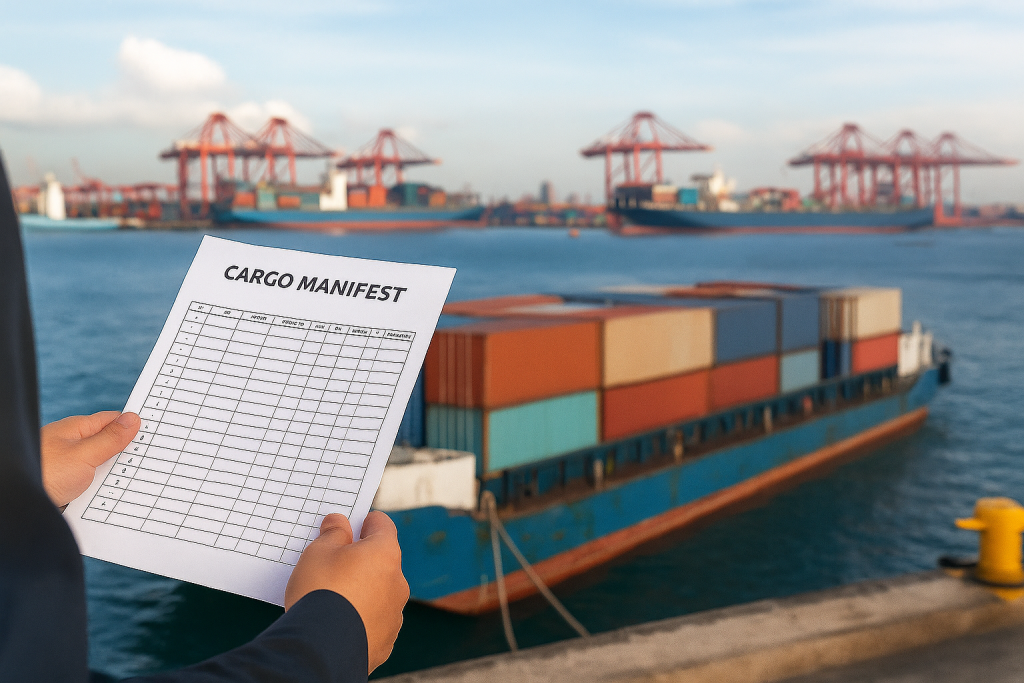
In international trade, manifests are categorized into several types based on the mode of transportation and their intended purpose:
- Sea Manifest (Sea Manifest): The most common type, used for vessels and containers.
- Air Manifest (Air Manifest): Includes the list of shipments carried on a single flight.
- Road Manifest (Road Manifest): Used for cross-border road transportation.
- Electronic Manifest (E-Manifest): The digital version that is submitted online to customs authorities.
For example, a cargo aircraft may receive its Air Manifest from the airline, listing all exported packages along with their weight, package number, consignee, and destination. This allows the customs office at the destination to work more efficiently.
Benefits of Using an Electronic Manifest
Digital transformation in the transportation industry has led many countries to adopt electronic manifests. Some of the advantages of this type include:
- Faster transmission and processing of information
- Reduced human error in data entry
- Reduced printing and archiving costs
- Faster access for customs authorities to the information
- Real-time shipment tracking capability
For example, in an electronic system, the transport company can send the manifest directly to the customs platform so that the information is ready before the vessel arrives; as a result, the vessel can be unloaded more quickly.
The Role of the Manifest in Customs Control and Supervision
The cargo manifest is a key tool for controlling the entry and exit of goods. Customs officers compare the information recorded in the manifest with that in the bill of lading to ensure the accuracy of the shipment route and the type of goods.
If any discrepancies are found, a more thorough inspection process is carried out. For this reason, the accuracy of the information in this document is critical, and any error may result in fines or delays in clearance.
Imagine that the manifest records the shipment weight as 2,000 kg, but the bill of lading lists it as 2,500 kg; in this case, customs may stop the shipment, conduct an inspection, and impose additional charges.

Legal Requirements and International Standards
At the international level, organizations such as the International Maritime Organization (IMO) and the World Customs Organization (WCO) have established standards for how manifests should be prepared and submitted.
In many countries, providing an electronic version of the manifest before the vessel arrives at the port is mandatory. These requirements help reduce smuggling, increase transparency, and improve border management. For example, in Country X, the transport company must submit the electronic manifest to customs at least 24 hours before the vessel arrives.
Common Errors in Preparing a Cargo Manifest
Although the cargo manifest is a very important document, many companies still make mistakes when preparing it. Some common errors include:
- Incorrect entry of the bill of lading number or container code
- Lack of consistency between the information in the manifest and the bill of lading
- Failure to update the information before submitting it to customs
- Errors in specifying the weight or type of goods
Avoiding these mistakes requires careful verification and the use of specialized transportation management software.
For example, transport company “B”, due to using a handwritten system, recorded the container number as 1234568, while the actual number was 1234569. This discrepancy caused the vessel to be flagged for inspection at the destination port, resulting in additional costs.
Summary and Conclusion
The cargo manifest is one of the most important documents in the transportation and international trade process. It not only facilitates the clearance of goods but also plays a vital role in transparency and legal control. A thorough understanding of its components and the use of electronic methods for preparing and submitting it can significantly reduce the time and costs for transport companies.
In the end, every trader or transport company should understand that accuracy in preparing the manifest is the key to commercial credibility and faster customs procedures. Now that you are familiar with the concept, importance, components, differences, steps, types, advantages, supervisory role, standards, and common errors related to the cargo manifest, you have taken a stronger step toward establishing a professional process in international trade.
If you operate in the field of imports and exports and are looking to collaborate with a reputable company specializing in maritime transport and customs services, Arad Sahel Arvand Shipping Agency is ready to support you. By providing professional services in preparing and submitting the cargo manifest, cargo clearance, coordination with shipping lines, and expert trade consulting, we help streamline your international business operations. With the experience, precision, and commitment of Arad Sahel Arvand’s specialized team, you can be fully confident in the speed, transparency, and safety of your cargo transportation. Contact our experts today to benefit from professional services and comprehensive support.



 Persian
  English
No Comments